
Cultivating Wonder
- Pastor Trent

- Jun 10
- 4 min read

I spent last week on the campus of Austin Presbyterian Theological Seminary, where I attended my first intensive course for my Doctor of Ministry degree. The class for this session was called Wonder and Relationships, and it was an incredibly rich experience. We spent time talking about how our tradition calls us to be covenant partners with God, perceiving the divine shining forth throughout creation; yet our modern world has often rendered people and creation itself as objects to exploited rather than reflections of the divine image. The missing ingredient is often attention. There is so much to distract us, so much to hide behind, so many forces that push us to forget who and whose we are, that our attention has been dulled or diluted or shortened. What we need is practices that help us cultivate that attention, that help us perceive the divine radiance all around us.
One of the practices that we engaged in was a centering exercise each morning and afternoon. Each student would take a turn presenting an altar representing an important person or place that has shaped us and brought us to this moment. There were beautiful presentations of photographs, mementos, objects, and even food that represented family members, mentors, or special moments. I chose to talk about my grandparents, reflecting on their home which nurtured me and my calling from an early age. Here’s what I shared:
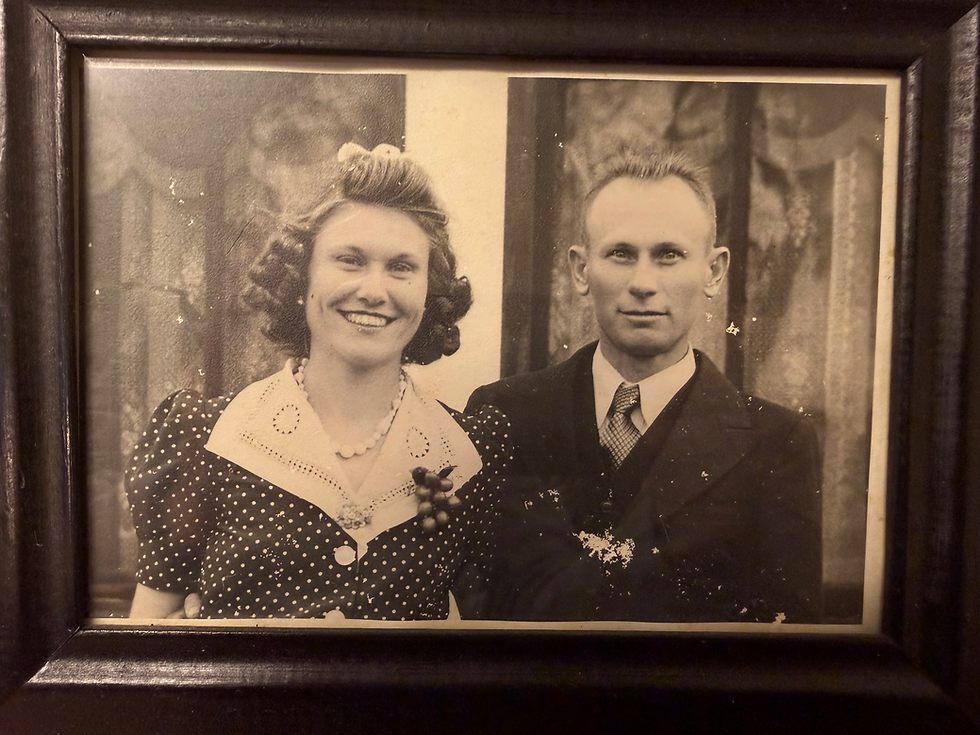
These are my grandparents, Edwin and Louise. I keep this picture in my office, as a reminder of them and of the place where my wondering about faith began.
When I was growing up, we spent Saturday nights at their house since my dad worked the night shift, and on Sunday mornings we would go to church together and then return to their home for lunch after. The Sundays I remember most clearly are Communion Sundays. Our congregation was rooted in the German Evangelical and Reformed stream of the UCC, and in that tradition you weren’t allowed to take communion until you were confirmed. So I had to let the trays pass me by, even though I really wanted to partake.
When we would get back to their house, though, I would keep the worship going by playing. By grandfather always kept Nilla Wafers in the house, so I would take the Nilla Wafers and use them to have communion since they reminded me of the communion wafers. My grandmother always encouraged my play church and I think that that’s where my call story originates.
My grandmother also loved music, and she had an old Hammond organ in her house. She didn’t really read music, but she did play by ear and she always kept this copy of the hymnal on the organ. She died when I was 7, and my mom brought the organ and the hymnal to our house. I always loved leafing through it, and I got to know the hymns intimately through this book. The front of the hymnal also has the worship liturgies from the Book of Worship, and I used to look at them sometimes and wonder about what they meant.
I thought too about how the relationships that began in that small house continued to nurture my call years later when I was a seminary student. My family had joined a large Baptist congregation when I was in high school, which had been my dad’s tradition. In college I began to sense a call to ministry there but I was also struggling with my orientation and knew that there was no way to reconcile that reality with my call in that tradition. I thought about going the academic route and teaching, when I got a call from my old church, my grandparent’s church, asking me to supply preach for them one Sunday. It was my first time preaching a Sunday morning service, and I enjoyed it but still felt conflicted about where I was being called. A few days later I got a call from someone at a small UCC church in a nearby town. The sister of a woman in that church went to my old home church and called her sister right after I preached there and told them to call me and invite me to preach for them since they were without a pastor. They asked me be their student pastor and my sense of call was confirmed in that moment.
I still wasn’t really out yet though, and I wasn’t sure whether I could be. Not long after that I traveled to the UCC General Synod, where the big issue that year was a vote to affirm marriage equality for all couples. After the resolution passed, the president of the denomination came to one of the microphones to offer a prayer. And he opened it with words I had read many times in my grandmother’s hymnal, words that ended the Communion liturgy:
Lord Jesus, to thee we live, to thee we suffer, to thee we die. Thine will we be in life and in death.
I felt a profound weight lift and I knew that I was on the right path. This is the prayer:
Lord Jesus, to You we live, to You we suffer, to You we die.Yours will we be in life and in death.
Today, as in ancient Bethlehem, the hopes and fears of all the years are met in You.
We give thanks for Your presence during these days of prayer and discernment, and especially for Your presence here this morning.
We have felt Your warm embrace stilling us as we tremble with joy, with hope, with fear, with disappointment.
Remind us that as we are tempted to run from each other, so too we run from You.
We know that every choice confers a cost, so let us attend in the coming hours and days to those for whom this decision confers a particular burden.
Let us find words that comfort rather than congratulate.
Let us seek to be a community of grace and forgiveness rather than organizing constituencies of protest.
Let us use our hands not to clap, but to wipe away every tear.
And in all this, may we know in surprising new ways the comfort of belonging to You.
This is our prayer.Hear us, Lord Jesus.
Amen.
Those words confirmed my call and my belovedness. And it began with two people who loved me unconditionally, in a little house, playing church.


Comments